The books
A companion essay for every chapter. The essays are not the chapters. Each takes one idea out and argues it on its own, so it reads without the book in front of you.
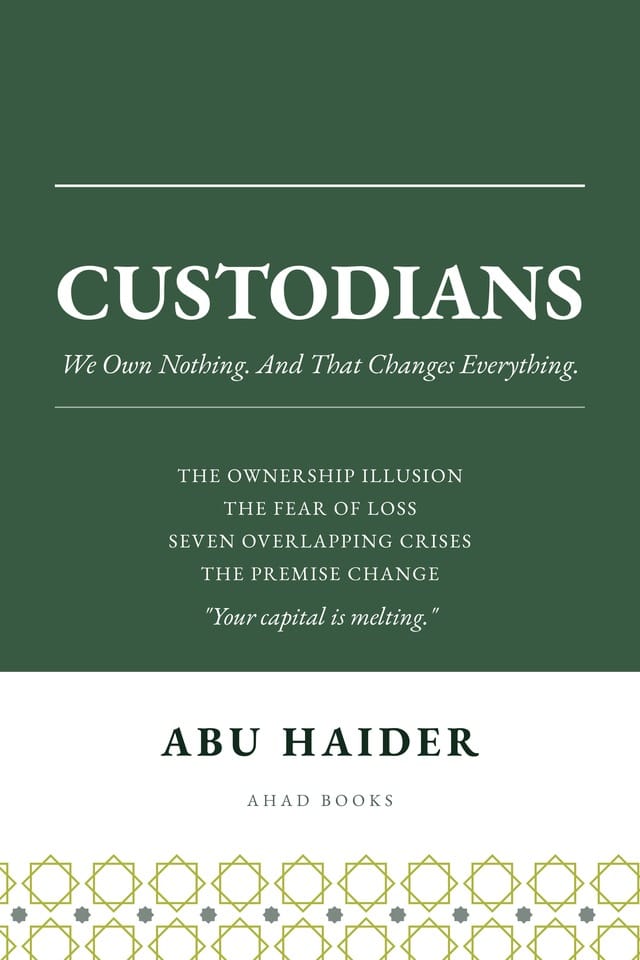
Custodians
We Own Nothing. And That Changes Everything.
Your capital is melting. Every moment that passes is evidence that you possess nothing permanently.
A scholar once understood the meaning of life from an ice-seller crying in a marketplace: "Have mercy on the one whose wealth is melting away!" In that single cry, he grasped what fourteen words of Quran had already told him: that mankind is in loss, and the exit from that loss has four conditions.
Custodians traces the ownership illusion from the individual who cannot stop accumulating to the civilisation that cannot stop consuming. It maps a single flawed premise, the conviction that we are owners rather than trustees, through fear, exploitation, and seven overlapping crises that the modern world treats as separate problems but which share one root.
Drawing on Surah Al-Asr, the Names of Allah, and the lived reality of communities that never forgot they were holding things in trust, Abu Haider argues that the corrective is not a policy, a programme, or a philosophy. It is a premise change. There is already an Owner. His name is Al-Malik. And everything we hold will return to Al-Waarith, the Inheritor.
This is not a sermon. It is a diagnosis. Written by a man with the same melting ice as everyone else.
The Turning of Days
Civilisational Decline, Islamic Renewal, and the Coming Age
Three independent frameworks (Ibn Khaldun's five-generation cycle, Sir John Glubb's seven ages of empire, and Strauss and Howe's theory of turnings) reach the same conclusion about the modern West: it is in structural, civilisational decline. This convergence across six centuries of scholarship, spanning Islamic, British, and American analytical traditions, is not coincidence. It is pattern recognition.
The five-hundred-year record of Western global dominance (fifty-six million indigenous Americans dead, thirteen million Africans enslaved, one hundred million excess deaths in British India alone, culminating in twelve thousand five hundred nuclear warheads) constitutes the most sustained ledger of destruction in human history. Meanwhile, two billion Muslims, deliberately fragmented by the nation-state, nationalism, and a debt-based financial system, have been rendered incapable of collective action. The instruments of fragmentation are identified. The alternative is articulated.
The Turning of Days argues that the current moment is not one of gradual reform but of civilisational reckoning, and that Islam offers not a protest movement within the existing order but a replacement of its philosophical foundations. The Ummah's renewal is not an Islamic project. It is a human necessity.
The Chain of Light
How Knowledge Travelled, from Adam to the Age of AI
The Renaissance was not a resurrection. It was a translation, from Arabic into Latin, of knowledge that had been alive and evolving for five hundred years while Europe slept.
Six thousand years before Stonehenge, hunter-gatherers in southeastern Turkey raised carved stone pillars in planned enclosures and cut a lunisolar calendar into one of them. They were not supposed to be capable of it. The popular explanation is a lost continent. The academic one is an embarrassed silence. There is a third, and it leaves the achievement with the people who left the evidence.
The Chain of Light follows the longest relay in human history across twelve millennia and a hundred civilisations: Sumer and Egypt, the Indus and China, Africa and the Americas, Baghdad and Córdoba and Toledo, the Renaissance, the Enlightenment, the colonial century, and the machines we have now built to do our thinking for us. It traces how knowledge is made, carried, translated, taken, forgotten and recovered, and it keeps the register of who handed what to whom.
Its organising idea is borrowed from the Islamic science of transmission: the silsila, the chain of names by which a saying is traced back to the mouth that spoke it. Extended to the whole of human understanding, it yields an uncomfortable conclusion. Knowledge is not property. It is amana, a trust, held for a while and handed on. No one owns it, and every civilisation that has tried to has lost it.
The chain is not broken. It never was. But it requires conditions, and almost nowhere on earth still reliably provides them. Whose hand holds it next, and will they have time?